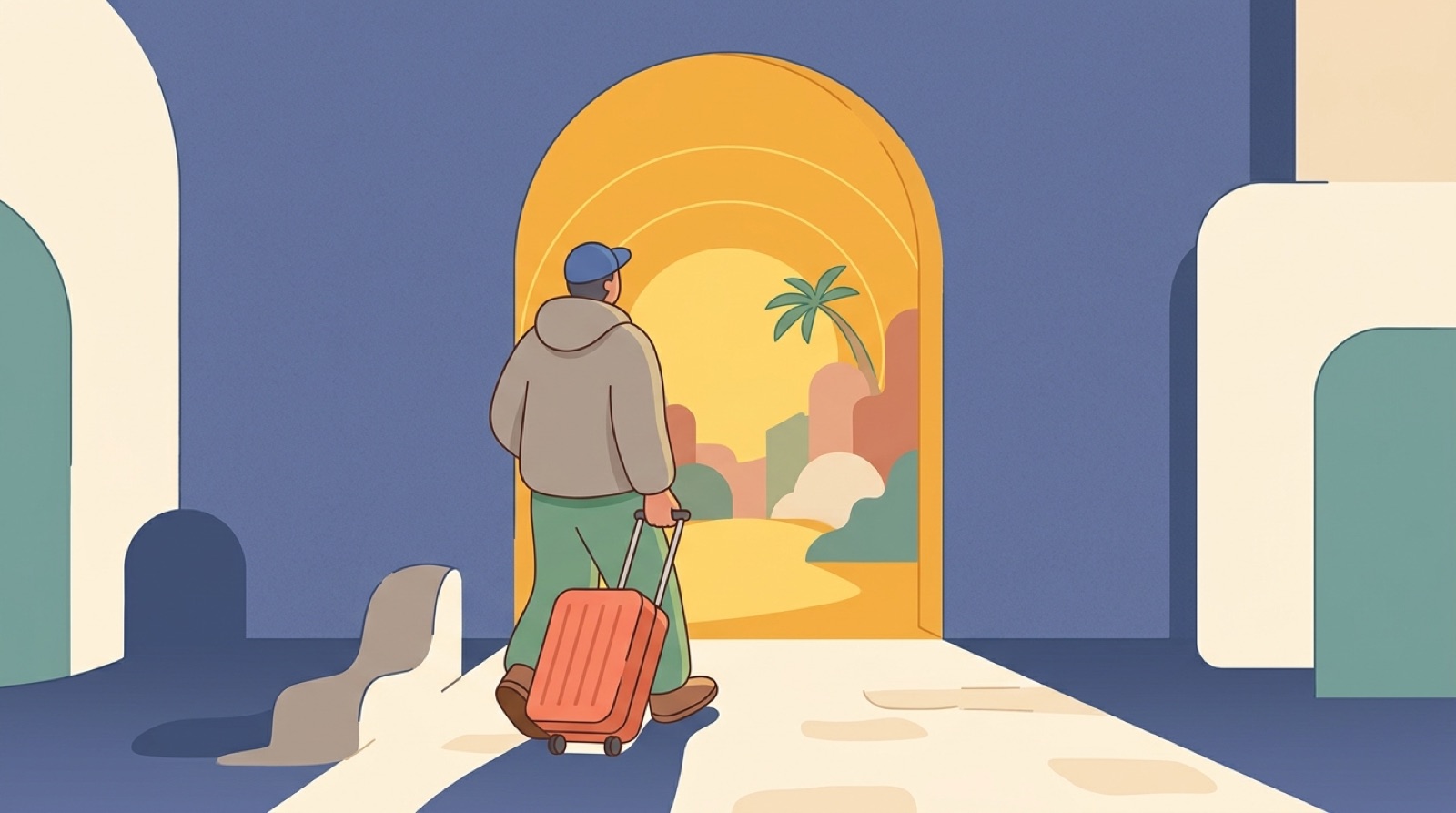
That change makes sense
Maybe you have flown comfortably for twenty years. Statistics were your religion, the numbers always worked, and then one week a crash owned your feed and the numbers stopped reaching the feeling. Now there is a flight on your calendar and a version of you that suddenly does not want to get on it, and underneath that, something almost worse: feeling foolish about the whole thing.
Nothing about that sequence is foolish. You watched something terrible, repeatedly, in high definition, from angles no previous generation of flyers ever saw. Your nervous system did what nervous systems are built to do with vivid, terrible, repeated images: it filed them as nearby danger. The feeling changed because the input changed. That is not a malfunction, and it is not a new identity. You are not a fearful flyer now. You are a comfortable flyer having a hard week.
Two promises about this page, because you have probably already been burned by the coverage. It names no incident, no airline, no place, and it speculates about nothing, because speculation is the fuel this fire runs on. And it quotes no odds and no safety records, because you already know the numbers, the numbers are not the wound, and a statistics lecture aimed at a spiraling brain mostly teaches it that nobody is listening. When facts are wanted later, they keep.
What a news spike actually does
It helps to understand the machine you are inside this week, because the machine is not aviation. It is coverage.
The feed learns what you linger on. You watched the story once, so it showed you the story again, then the analysis, then the animation, then the eyewitness clip. Within a day, your feed looks like the sky is falling, because a feed is a mirror of your attention, not a sample of the world. Planes did not start failing this week. Your feed started concentrating.
Then the clustering illusion arrives. Suddenly there are aviation stories everywhere, and a reasonable brain asks the question people always end up typing at two in the morning: at what point does it stop being a coincidence? Here is what is actually happening: after a major event, incidents that would never have been news, the diversion, the rough landing, the maintenance return, briefly become news, because the topic is hot. Coverage clusters. That is a property of newsrooms and algorithms, not of aircraft. When the topic cools, those small stories go back to being invisible, and the sky will not have changed either time.
Meanwhile your body is running a spike: sleep a little worse, images intruding at random moments, the flight on the calendar glowing like a deadline. A spike has a shape. It crests in the first days while the coverage is everywhere, and it fades as the feed moves on. Knowing the shape matters, because everything in the next two sections is about not making permanent decisions inside a temporary crest.
Permission to step away from the coverage
Somewhere in the last few days you have probably re-watched the coverage to feel prepared, and noticed it does the opposite. So here is the permission that people mid-spike seem to need from somewhere outside their own head: you are allowed to step away from the coverage without pretending it did not happen. Stepping away is not denial. Denial says nothing happened. Media hygiene says something happened, it is being investigated by people whose whole profession is finding out why, and watching the same footage an eleventh time adds nothing to their work or to your safety.
Practically, for the next while:
- Mute the words, not your friends. Most platforms let you mute topics and keywords. Do it without guilt and without announcement. You can unmute in a few weeks.
- No footage replays. Each replay is a rehearsal, and your body cannot tell rehearsal from experience. You have seen it. Seeing it again is not information, it is re-exposure.
- If you truly need to know, read once, from one reputable source, in text. Text is quieter than video. Then close the tab and let the follow-up wait for the investigators, whose honest answer for a long time will be the only honest answer available: we do not know yet. Sitting with we do not know yet is uncomfortable. It is also the truth, and the speculation filling that silence is not.
Do not make the decision inside the spike
The most common casualty of a news week is not a flight. It is a booking, cancelled in the crest by someone who had been powering through for years, and who then has to live with what the cancellation taught their fear: that avoidance works, and that the feed gets a vote.
So the rule, and it is the closest thing this page has to a commandment: no booking decisions during the crest. Not cancelling, and honestly, not booking some defiant extra trip either. The spike distorts every input it touches. A decision made inside it is a decision made by the spike, wearing your voice. Give it days. Decisions that are right will still be right after the fade.
If your flight is very soon, before the fade can arrive, then fly the plan you already had, not the plan the news wrote for you. The tools you know, the routine you know, the seat ritual you know. And hold on to the community's steadiest sentence for exactly this situation: brave and scared at the same time. Both are allowed on the same flight. Most comebacks are made of both.
And if you built skills before this week, hear this clearly: a spike does not erase progress. The people who post at midnight afraid they are about to lose all the progress they made are asking the right question a week too early. The skills are still there. Interrupted is not erased. Relapse after aviation news is one of the most ordinary shapes recovery takes, which is exactly why it should not be read as a verdict.
The news changed how flying feels. That makes sense.
The app is a plan instead of a spiral: it works out which pattern the fear is running, then builds the route back. The tools work offline, in the seat.
The way back to your baseline
This is not the lifelong-fear track. You had a baseline where flying was boring, which means the route back is shorter than you fear, because it leads somewhere your body already knows. What walks it:
- Give your body a daily off-ramp. The spike lives in the body, so meet it there: a breathing pattern with a long exhale, practiced a few minutes a day, ideally at the same time, so your nervous system relearns that the alarm can end on schedule.
- Reintroduce flying in small, chosen doses. Not the coverage, flying itself: the friend's boarding photo, a landing video shot by someone delighted, the flight-tracker showing the ordinary river of dots crossing the ocean tonight. You are re-teaching the association the news overwrote, on your terms.
- Save the numbers for the fade. There will come a week when the statistics feel like solid ground again instead of gaslighting. The data page will be there for that calmer week. Reading it tonight is not required and probably not kind.
- Talk to people who get it. A community of flyers in the same week, some of them flying tomorrow and saying so, does more for a spike than any fact sheet.
- If it is not fading, get a professional in your corner. If weeks pass and the spike is spreading rather than shrinking, into sleep, into the car, into dread of the calendar itself, that is not a failed recovery, that is the signal to add help. A therapist who works with anxiety has seen exactly this arrival story many times. Bringing one in is the strong move, not the surrender.
The week the feed was on fire, someone you will never meet was quietly taking their comfortable, boring flight, and next month, back at baseline, that someone can be you. The way back is not pretending the news never happened. It is refusing to let one week of coverage rewrite twenty years of evidence your own body collected.
Frequently asked questions
This article is for informational and educational purposes only.